

How Recovery Helped This Creator Navigate the Pandemic
By Dean Stattmann • November 11, 2021
This article is brought to you as part of the ASCAP Wellness Program.
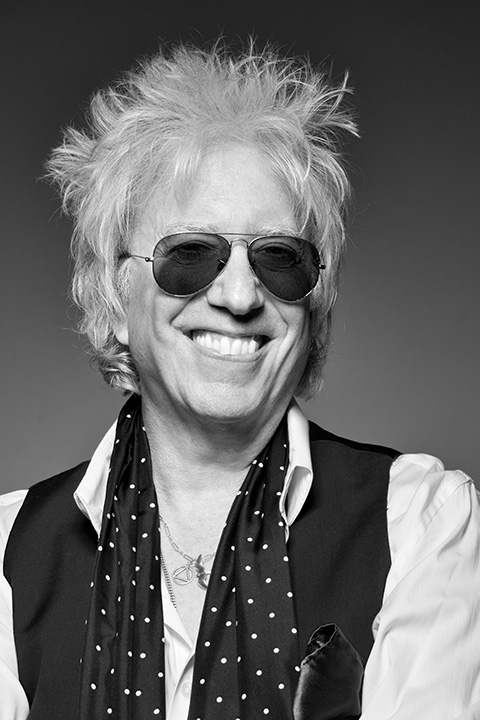
Since making landfall in the United States, the coronavirus pandemic has lorded over us like a menacing storm spanning far and wide, merciless and indiscriminate. But in March 2020, New York City was its lightning rod. For the first couple of weeks, residents of the Big Apple quite literally didn’t know what had hit them, and by the time they did, it was already too late for many.
“Last March in New York was scary,” says Ricky Byrd, an ASCAP member and Rock & Roll Hall of Famer best known for his decade spent as a guitarist and backup vocalist for legendary rock band Joan Jett and the Blackhearts.
Byrd likens those first few weeks to a Steven Spielberg movie: “There were sirens everywhere, people were dying, there were morgue trucks…I remember sitting on the couch and thinking, ‘Man, I am so grateful I am not that person anymore.’”
He’s referring to Ricky Byrd, the addict. That version of Byrd hasn’t existed for about 34 years, but the Ricky Byrd of today – the “Recovery Troubadour,” as he’s become known for his unique brand of recovery-centric music – is confident he wouldn’t have made it this far in life, and certainly not nearly two years into the pandemic.
Ironically, however, it’s his hard-earned pivot from that self-destructive version of himself, now long gone, that Byrd credits with the resilience and tactical toolkit that he possesses today and has found particularly useful in navigating the pandemic with confidence, composure and event contentment.
Ditching drugs and alcohol 34 years ago wasn’t easy, but it prepared Byrd for every challenge he has faced since, including this one. “When the pandemic hit, I went into ‘recovery automatic,’” he says, describing a sort of psychological autopilot setting that kicked into gear when things started to get rough last year.
It’s easy for Byrd to imagine how the pandemic could have gone the other way for him, had he not had the confidence to seek recovery nearly four decades ago.
“I can imagine convincing myself and my family that I’ll be back in 15 minutes,” he says, referring to making a drug run, “even though we’re in this freakin’ movie where you don’t want to even see anybody. I remember, we were washing cans every time we went to the market, yet I could imagine convincing myself that it was fine. That’s how I would have thought as an addict. You justify stuff that you do, in spite of knowing the consequences. Even though you didn’t want to leave your house and people were so sick – and dying. I was just so grateful that that wasn’t me anymore. I would not be here today, for sure.”
Of course, Ricky Byrd is here today, in all his glory and then some – louder, badder and shredding harder than ever. “My guitar playing got so much better when I got clean,” he says. “I got more consistent, and I wanted to learn again.” For evidence, look no further than Byrd’s most recent release, Sobering Times. “The lyrics speak to addiction, recovery, hope and inspiration,” Byrd says. And for anyone in need of recovery or interested in not only its life-saving potential but its life-proofing benefits, simply read on.
How Recovery Helped Ricky Byrd Navigate the Pandemic
1. It taught him that he didn’t have to struggle in silence
Similar to this pandemic, ubiquitous as it is, recovery can be a challenging, personal and sometimes isolating process. However, also not unlike the pandemic, recovery is something that many of us are going through together, even if it doesn’t always feel that way.
Putting his recovery out in the open for all to see was instrumental in helping Byrd get to a place of consistent sobriety. As he puts it, “I got high in front of everybody, didn’t I?”
Byrd’s megaphone of choice was the one he already knew well – his music – and his recovery-focused songs and albums – like Sobering Times and 2017’s Clean Getaway – have since inspired countless others to follow his lead along the path to getting sober.
So when the pandemic took hold and the country went into lockdown, he knew that this was not a battle he needed to fight alone. Almost immediately, he joined a Zoom group that took place at noon every single day. “I just fell in love with it,” he says. “There were a lot of different kinds of people in there, and I wound up going to that meeting every freaking day for maybe the first seven months of this thing.”
“I became part of the group,” he says. “That was unbelievably helpful – to me, and maybe stuff that I said to the other people. It really carried me through the worst parts of this.”
2. It allowed him to rediscover childhood joy
As the haze of addiction cleared, Byrd’s true passions came back into focus. “Baseball is the only sport that I watch. Period,” he says.
Growing up in the shadow of Yankee Stadium, Byrd found the sport at an early age and became instantly obsessed. “There’s just something about baseball,” he says. “People who don’t understand it, they watch it and they’re completely bored, but I understand the technique and what’s happening behind the scenes – and I love that.”
While the pandemic isn’t over yet, baseball is back and with every game he watches Byrd is transported out of this dark chapter and back to his childhood, along with the feeling that hooked him on America’s Pastime in the first place. “I think that is probably the most important thing,” he says. “I just sit there and then I’m 12 years old again, and nothing else matters for like three and a half hours.”
3. It showed him there’s more than one way to get to where you’re going
One of the most frustrating things about this pandemic is that it is not a problem with a simple solution, or even a single solution; from vaccines to masks to social distancing to all-out isolation, there are myriad ways to be safe and even more opportunities for missteps. But Byrd hasn’t thrown his hands in the air, because he’s learned that life rarely throws us a challenge with just one solution, including getting clean.
“There are 100 different ways to get sober,” he says. And switching to a wide-angle lens allowed Byrd to place his drug problem into context and see a new path forward.
“Someone suggested I focus on the alcohol instead of just the drugs, and I started thinking, ‘You know, every single time I drink I end up picking up other stuff; maybe if I cut the head off the snake, as they say in mob movies, I could fix this thing.’”
It’s one of the most important lessons he teaches today – that the last thing anyone should feel is pressure to recover in a specific way. “You want to go to church? You want to join a bowling league? Whatever works and makes it happen for you is the way to go,” he says. “Whatever keeps you on the right side of the grass.”
4. It taught him not to panic every time something unexpected happens
When Byrd thinks back to how he dealt with unexpected challenges in the fog of addiction, he shakes his head. “I had lousy coping skills back then. Panic mode,” he says. “I made a lot of decisions out of fear before I got into recovery, and that never works out well.”
He describes his outlook before recovery as always waiting for the other shoe to drop – fearing the inevitable, yet plowing ahead with his addictions nonetheless. He remembers living afraid of what was around the corner – especially in an industry like music, he says, which is “up and down and sideways.”
Thankfully, recovery changed all that, or at least the way he perceived that instability. “Over time, it taught me how to deal with things,” Byrd says. “Now I very rarely go into panic mode. I’ve grown to believe there may be something great around the corner.”
So when the pandemic threw Byrd, along with the rest of us, into deep, uncharted waters, he was ready to confront the challenge head-on. Simply put, he says, “I’ve been in training for this.” He doesn’t claim to have all the answers. But he’s learned to accept the things that are out of his control, and to take ownership of those that are within his reach.
“It’s a scary world to live in,” he says. “There’s a lot to be afraid of. But, with that said, you can’t have that rule your life, where you’re like a deer in the headlights and you’re afraid to do anything. If recovery taught me nothing else, it’s to keep my eyes and ears open, not panic, and realize that everything happens for a reason.”
5. It revealed that anything is possible when you take it one step at a time
When Byrd first started on his recovery journey, like anyone, he had a lot more questions than answers. Fortunately, he found an ally who would serve as a guiding voice through the early stages of his process. That said, the answers he received didn’t make a whole lot of sense, at least in the beginning.
“I’d ask, ‘What do I do?’ My guy that I was working with back then, he would always respond with, ‘Just do the next right thing.’ Do the next right thing? I’d ask, ‘What does that mean?’ And again, he’d say, ‘Just do the next right thing.’ I’d say, ‘Okay, I have no idea what you’re talking about. What is the next right thing?’ And then he’d say, ‘More will be revealed.’ I’d get so angry!”
“But the point is,” Byrd says, “more was revealed.”
The longer he stayed in recovery, the more he learned. “It’s just like you have to learn how to roll a joint or make a good martini,” Byrd explains. “You learn how to be in recovery.”
It’s an easy parallel to draw with the pandemic, and a lesson that has enabled Byrd to trust the process and appreciate the progress that is being made day by day. “Don’t expect everything to happen in one day,” he says. “Just keep doing the next right thing.”
********
+Read our 2018 interview with Ricky Byrd about non-profit Clean Getaway
Visit Ricky Byrd on the web: rickybyrd.com